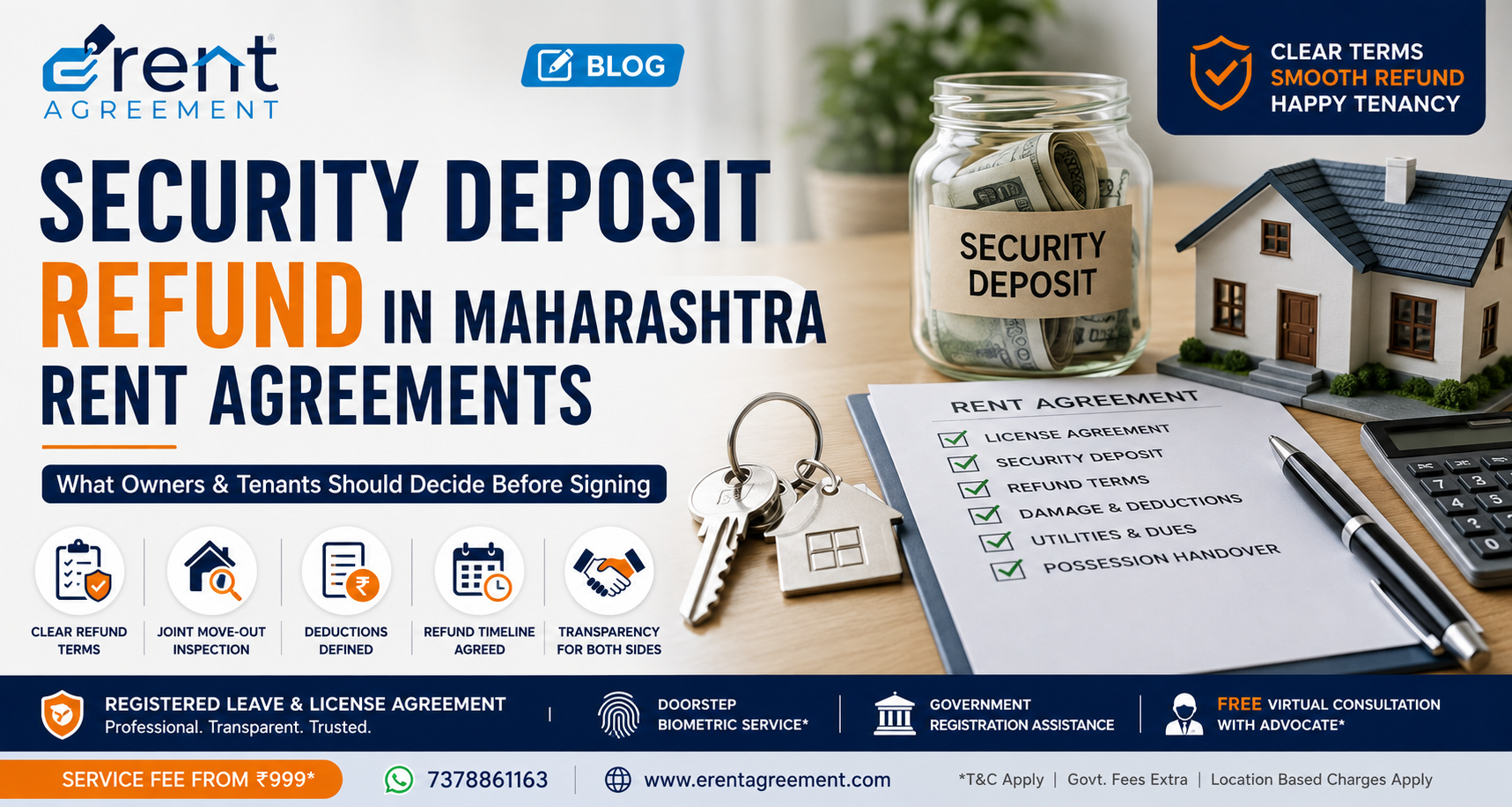
Security Deposit Refund: One of the Most Important Clauses in a Rent Agreement
When a new tenancy begins, most discussions focus on:
- Monthly rent
- Security deposit amount
- Agreement duration
- Possession date
But there is another question that should be discussed before the agreement is signed:
When and under what conditions will the security deposit be returned?
A security deposit can become one of the biggest reasons for disagreement when a tenant vacates a property.
The solution is simple: define the refund process clearly in the Registered Leave & License Agreement.
What Is a Security Deposit?
A security deposit is an amount paid by the tenant to the property owner at the beginning of the tenancy.
It is generally held as security against obligations such as:
- Unpaid rent
- Pending electricity or utility bills
- Property damage beyond normal wear and tear
- Missing furniture or appliances
- Missing keys or access cards
- Other dues specifically agreed in the agreement
The exact conditions should be documented instead of being left to verbal understanding.
Is There a Standard Security Deposit Amount in Maharashtra?
There is no single deposit amount suitable for every property.
The amount can vary depending on:
🏠 Property location
💰 Monthly rent
🛋️ Furnished or unfurnished property
🏢 Society and property type
📅 Agreement tenure
🤝 Terms mutually agreed between owner and tenant
For this reason, the agreement should clearly state the exact security deposit amount.
The Most Important Question: When Will the Deposit Be Refunded?
This should never be left unclear.
The agreement can specify a mutually agreed timeline such as:
- Same day as possession handover
- Within 7 days
- Within 7–15 days
- After final utility bills are verified
The appropriate timeline depends on the arrangement between the parties.
Example Clause Concept
The parties may agree that the security deposit will be refunded within a specified number of days after the tenant hands over vacant possession, subject to adjustment of legitimate pending dues or damages.
The exact wording should match the actual arrangement.
What Can Be Deducted From the Security Deposit?
One of the biggest causes of disputes is an owner making deductions that the tenant did not expect.
A well-drafted agreement should define possible deductions in advance.
1. Unpaid Rent
If rent remains outstanding at the end of the tenancy, the agreement may allow it to be adjusted against the deposit.
2. Electricity Bills
Before vacating:
⚡ Record the final meter reading.
⚡ Check whether the last bill has been generated.
⚡ Keep proof of payment.
This can prevent disagreements over consumption after the tenant leaves.
3. Society or Maintenance Dues
If the tenant is responsible for certain maintenance or usage charges, the agreement should clearly define them.
Avoid vague wording such as:
"All maintenance to be paid by tenant."
Instead, specify exactly which charges belong to whom.
4. Property Damage
Owners and tenants should distinguish between:
Normal Wear and Tear
Examples may include:
- Minor fading of paint
- Normal ageing of fittings
- Small marks caused through ordinary use
Actual Damage
Examples may include:
- Broken fixtures
- Damaged furniture
- Large holes in walls
- Broken doors or windows
- Appliance damage caused by misuse
Clear documentation at move-in makes this much easier to determine.
Take Property Photos Before Possession
One of the simplest ways to reduce future disputes is to create a move-in condition record.
Before possession, photograph:
📸 Living room
📸 Bedrooms
📸 Kitchen
📸 Bathrooms
📸 Walls and ceilings
📸 Doors and windows
📸 Furniture
📸 Appliances
📸 Electricity meter
📸 Water meter
Both parties should keep copies where possible.
Furnished Property? Add an Inventory
If the property is furnished, the agreement or attached inventory should list everything being handed over.
For example:
- Bed
- Mattress
- Sofa
- Dining table
- Television
- Refrigerator
- Washing machine
- Air conditioner
- Water purifier
- Wardrobes
- Curtains
- Kitchen appliances
Also record the approximate condition where appropriate.
Better:
1 Refrigerator – Samsung – Working Condition
Instead of simply:
1 Refrigerator
This creates much better clarity at the end of the tenancy.
Don't Forget the Keys
Security deposit disputes aren't always about property damage.
Sometimes they are about missing access items.
Record:
🔑 Main door keys
🔑 Duplicate keys
📬 Letterbox key
🚗 Parking remote
🏢 Society access cards
🛗 Lift cards
🔐 Smart-lock credentials
When the tenancy ends, confirm that all items have been returned.
Should Painting Charges Automatically Be Deducted?
This depends on the terms mutually agreed in the agreement and the actual condition of the property.
Owners should avoid assuming that every tenant must automatically pay full painting costs unless such responsibility has been clearly agreed.
Similarly, tenants should understand any painting or restoration clause before signing.
The agreement can define:
- Whether painting is required at move-out
- Who bears the cost
- What constitutes damage
- Whether restoration is required for holes, stickers or modifications
Cleaning Charges Should Also Be Clear
Some owners expect professional cleaning when possession is returned.
If that is the expectation, write it into the agreement.
For example, the agreement can specify that the property should be returned in a clean and reasonable condition, subject to mutually agreed standards.
Clear wording is better than surprise deductions later.
Conduct a Joint Move-Out Inspection
Where practical, the owner and tenant should inspect the property together.
Check:
✅ Furniture
✅ Appliances
✅ Walls
✅ Bathrooms
✅ Kitchen
✅ Doors and locks
✅ Keys
✅ Meter readings
✅ Pending utility bills
✅ Society dues
If there is damage, photograph it immediately.
This makes the final settlement much more transparent.
Security Deposit Refund Checklist for Owners
Before making the final refund, verify:
✅ Rent paid up to the agreed date
✅ Electricity bill status
✅ Water charges
✅ Maintenance obligations
✅ Furniture and appliances
✅ Property condition
✅ All keys returned
✅ Meter readings recorded
✅ Vacant possession received
Once deductions, if any, are agreed or properly supported, complete the refund within the timeline stated in the agreement.
Security Deposit Checklist for Tenants
Before handing over possession:
✅ Clear outstanding rent
✅ Pay applicable utility bills
✅ Remove personal belongings
✅ Clean the property
✅ Return all keys and access cards
✅ Take final photos
✅ Record meter readings
✅ Ask for acknowledgement of possession handover
✅ Keep proof of deposit settlement
Documentation protects both sides.
Avoid Cash-Only Settlements Without Records
Where possible, maintain a proper record of:
- Security deposit received
- Refund amount
- Deductions
- Balance refunded
- Date of refund
Electronic payment records can help establish when and how the settlement occurred.
If cash is used, obtaining written acknowledgement is advisable.
What If the Owner and Tenant Disagree About Damage?
First check:
- The registered agreement
- The inventory
- Move-in photographs
- Move-out photographs
- Payment receipts
- Communication between the parties
Many disagreements become easier to resolve when the original condition of the property has been documented properly.
This is exactly why deposit clauses should be detailed before the tenancy starts.
Common Security Deposit Mistakes
❌ No refund timeline mentioned
This creates uncertainty after possession is returned.
❌ No inventory attached
The parties later disagree over what furniture existed.
❌ No property photos
Neither side can clearly establish the original condition.
❌ Vague maintenance clause
Both parties believe the other person is responsible.
❌ No meter readings
Utility-bill disputes become difficult to resolve.
❌ Unrecorded key handover
Neither party remembers how many keys were originally given.
❌ Verbal promises
Important conditions should be documented.
A Good Deposit Clause Protects Both Parties
Security deposit clauses should not be drafted only to protect the property owner.
They should create a fair and predictable process for both parties.
For owners, they provide clarity regarding legitimate deductions.
For tenants, they provide clarity regarding:
- When the money will be returned
- What can be deducted
- What evidence may be required
- What responsibilities must be completed before moving out
That transparency can significantly reduce conflict.
Frequently Asked Questions
When should a security deposit be refunded?
The refund timeline should be mutually agreed and clearly stated in the Rent Agreement. Parties may choose same-day settlement, a few days after possession, or another reasonable period depending on pending bills and inspection requirements.
Can electricity bills be deducted from the deposit?
If the tenant is responsible for electricity charges and a genuine bill remains unpaid, the parties may provide for adjustment in the agreement.
Can an owner deduct money for property damage?
The agreement can allow deductions for damage attributable to the tenant, subject to its terms and the circumstances. Documenting the property's move-in and move-out condition is very helpful.
Is normal wear and tear the same as damage?
No. Normal usage naturally causes some ageing. The agreement should distinguish ordinary wear from actual damage wherever possible.
Should furniture be mentioned in the Rent Agreement?
For furnished properties, maintaining a detailed furniture and appliance inventory is strongly recommended.
Should the number of keys be recorded?
Yes. Recording the number and type of keys, remotes and access cards reduces confusion at possession handover.
Can cleaning or painting charges be deducted?
This depends on the mutually agreed terms and actual circumstances. If specific cleaning or restoration obligations are expected, they should be clearly documented in advance.
How erentagreement.com Helps
A professionally prepared agreement should cover much more than just rent and deposit.
With erentagreement.com, the process can include:
✅ Registered Leave & License Agreement
✅ Custom clauses based on mutually agreed requirements
✅ Draft review before registration
✅ Doorstep biometric service*
✅ Government registration assistance
✅ Police intimation assistance where applicable
✅ NRI and outstation coordination
✅ Digital delivery of the registered agreement
👨⚖️ FREE Virtual Consultation with a Practising Advocate worth ₹599 during the agreement tenure*
💰 Service Fee from ₹999*
📞 Call / WhatsApp: 7378861163
🌐 www.erentagreement.com
📍 Serving property owners and tenants across Maharashtra.

 +91-7378861163
  info@erentagreement.com
  8:00AM - 9:00PM