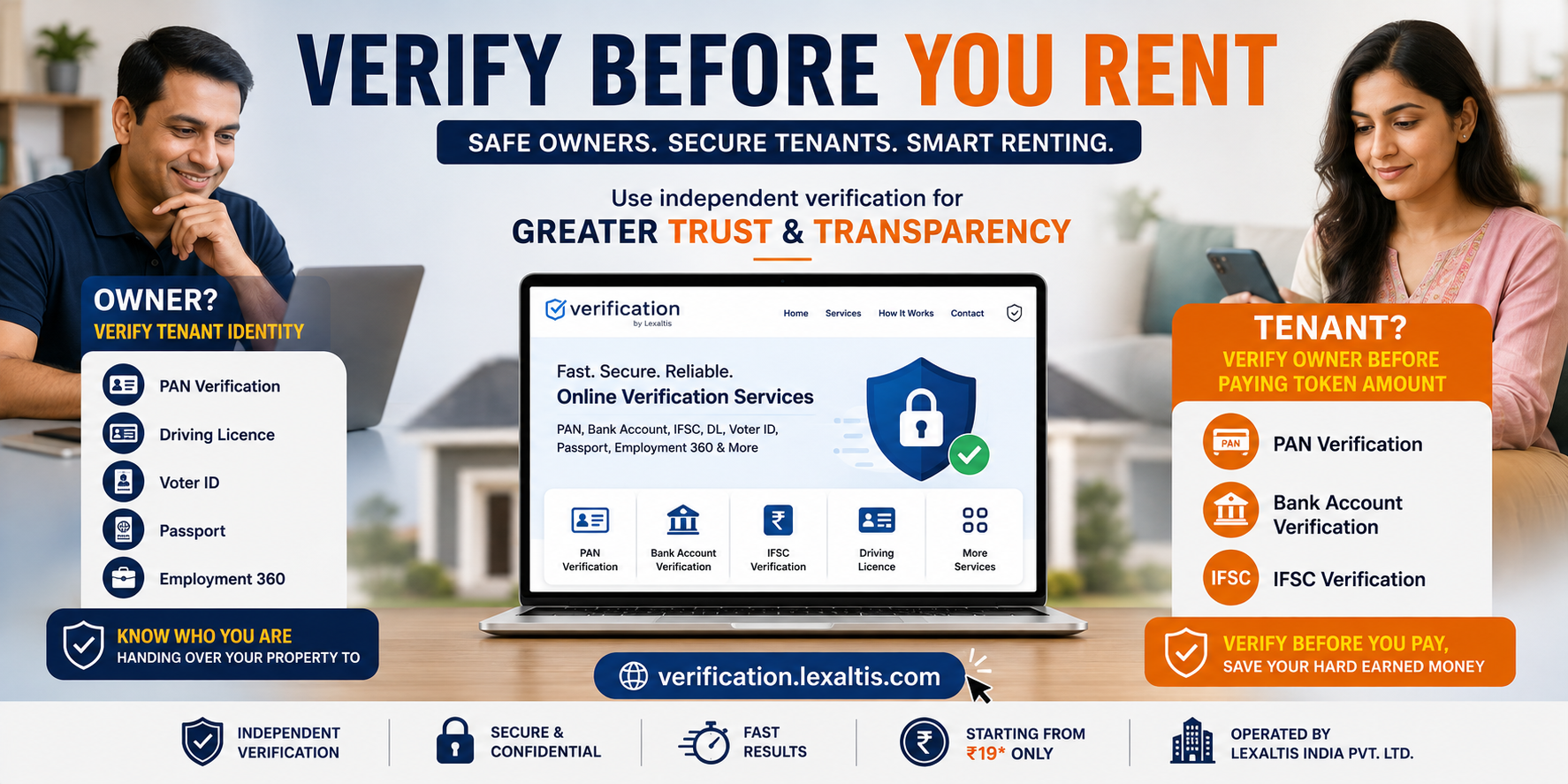
Tenant Verification Should Work Both Ways
When a property is rented, verification is often discussed only from the property owner's perspective:
“Have you verified the tenant?”
That is important—but today's rental transaction involves trust on both sides.
The Owner is handing over possession of a valuable property to someone they may have met only recently.
At the same time, the Tenant may be asked to transfer a token amount, security deposit or advance rent to someone claiming to be the property owner or an authorised representative.
So there are actually two important questions:
Owner → Have you verified the Tenant?
and
Tenant → Have you verified the person to whom you are about to transfer money?
With online verification tools now available, both parties can perform selected document and account checks before proceeding with the transaction.
The Lexaltis Verification portal currently provides online verification services including PAN Verification, Bank Account Verification, IFSC Verification, Driving Licence, Voter ID, Passport, Employment 360, Vehicle RC, GSTIN, CIN, Udyam and other checks. Paid verification checks currently start at ₹19, while IFSC verification is listed as free.
Quick Answer
Can a Property Owner Verify a Tenant Before Signing the Rent Agreement?
Yes.
With the tenant's lawful consent or authority, the Owner can use appropriate verification checks to validate details and documents supplied during the rental process.
For example, PAN Verification can check a submitted PAN against available verification records and return available status and registered details.
Depending on what documentation is relevant and voluntarily provided, other verification options may also be available, such as Driving Licence, Voter ID, Passport or Employment 360.
Can a Tenant Verify the Property Owner Before Paying a Token?
Yes—and this can be an important precaution.
Before transferring a token amount, security deposit or other advance payment, a Tenant can ask the Owner to provide appropriate verification details and consent for verification.
For example:
The Owner's PAN can be checked against available verification records to obtain status and available registered details.
The bank account into which the Tenant has been asked to transfer money can be validated using the bank account number and IFSC code.
This gives the Tenant another layer of information before transferring money.
However, there is an important limitation:
PAN or bank-account verification does not by itself prove ownership of the property.
The verification portal itself states that a verification result is not a guarantee of identity, ownership, solvency, authenticity or future conduct.
Therefore, verification should be treated as one part of a wider rental due-diligence process.
Why Tenant Verification Matters for Property Owners
Imagine handing over possession of a property worth ₹50 lakh, ₹1 crore or more to somebody based only on:
- A WhatsApp conversation
- A photocopy of Aadhaar
- A visiting card
- An employment claim
- A broker's assurance
Most tenancies are genuine and trouble-free.
But a prudent property owner should still know who is occupying the property.
Document verification can help the Owner check whether information supplied during onboarding is consistent with available verification records.
This can be particularly useful when dealing with a tenant found through an online property portal, broker, social-media group or personal reference.
A Better Tenant-Onboarding Process
Instead of collecting documents only for the sake of preparing the Rent Agreement, Owners can follow a more structured process.
Step 1: Ask for Basic Tenant Documents
Obtain only the documents genuinely required for the rental and registration process.
Step 2: Review the Details
Check that names and other information are consistent across the documents supplied.
Step 3: Perform Relevant Verification
Where appropriate and with lawful authority or consent, use a verification service to validate selected documents.
Step 4: Complete the Registered Leave & License Agreement
Once both parties are satisfied with the documentation, prepare and review the agreement.
Step 5: Complete Applicable Police Tenant-Information Formalities
Identity/document verification and police tenant verification are not necessarily the same process.
Maharashtra Police's citizen-services system includes a Tenant Verification Form, and individual police jurisdictions may also prescribe their own tenant-information procedures.
Step 6: Hand Over Possession
Complete the documentation first and then hand over the keys.
What Can an Owner Verify?
The appropriate verification depends on what the Tenant has supplied and what is actually relevant.
The Lexaltis Verification portal currently offers multiple checks.
PAN Verification
PAN verification accepts a 10-character PAN and checks it against available verification records.
The portal states that the response can include available status and registered details.
This can be useful as an additional consistency check during tenant onboarding.
If a Tenant has voluntarily provided a Driving Licence as part of the agreed verification process, the portal currently provides a Driving Licence check using the licence number and date of birth.
A Voter ID check is also available using the EPIC number.
For eligible situations, Indian passport verification is available using the passport file number and date of birth.
The portal currently lists an Employment 360 verification service based on UAN for retrieving available employment information.
Owners should only use such checks where relevant and where they have the lawful authority or consent required to submit the information.
Important: Do Not Over-Collect Tenant Data
Verification does not mean collecting every possible document from every Tenant.
A better principle is:
Collect what is necessary. Verify what is relevant. Protect what you collect.
Lexaltis Verification states that its verification forms ask only for the information necessary for the selected check and do not require a general customer name, mobile number or email address as part of the verification form.
This approach is useful because sensitive identity information should not be collected merely because it is available.
Tenant Safety Is Equally Important
Rental fraud does not affect only Owners.
Tenants can also be vulnerable—especially when looking for property remotely.
Consider this situation:
A person advertises an attractive flat.
The Tenant likes the photographs.
The person says:
“There are several other interested tenants. Pay ₹10,000 now to block the flat.”
The Tenant receives:
- A PAN image
- A bank account number
- A WhatsApp profile
- Some property photographs
Should the Tenant immediately transfer money?
No verification tool can eliminate every risk, but additional verification before payment can help the Tenant make a more informed decision.
Before Paying a Token Amount: Verify the Person Receiving the Money
If somebody claiming to be the Owner asks for payment, the Tenant should first understand:
- Who is receiving the money?
- Why is that person authorised to receive it?
- Does the payment account relate consistently to the transaction?
- Has the property itself been verified?
- Are the payment and refund terms documented?
A PAN and bank-account check can form part of this process.
How PAN Verification Can Help a Tenant
Suppose the person claiming to be the property Owner provides a PAN.
With appropriate consent or lawful authority, the Tenant can submit that PAN for verification.
The Lexaltis PAN Verification service checks the submitted PAN against available verification records and provides a structured response for reference.
If the information is inconsistent with what the Tenant has been told, that is a reason to stop and investigate further before transferring money.
A successful result, however, should not be treated as proof that the person owns the property.
Suppose the Tenant is told:
“Transfer the ₹20,000 token to this account.”
Instead of blindly transferring the money, the Tenant can ask for the bank account details and verify them where legally authorised.
Lexaltis Bank Account Verification uses:
Bank Account Number + IFSC Code
to validate the submitted account details and return a structured verification response.
This can provide an additional checkpoint before payment.
Again, it is important to understand what this does not prove:
A valid bank account does not automatically establish that the account holder owns the advertised property or has authority to rent it. The portal explicitly warns that its results are not guarantees of identity or ownership.
Never Verify Only the Bank Account—Verify the Property Too
A Tenant should not stop after verifying a PAN or bank account.
Before paying a substantial token or security deposit, it is sensible to check the supporting property and ownership documentation available for the transaction.
If a broker or Power of Attorney holder is involved, the Tenant should also understand why that person is authorised to act for the Owner.
Think of verification as layers:
Person → Payment Account → Property → Authority → Agreement → Payment
The more consistent these layers are, the better informed your decision becomes.
A Practical Pre-Token Checklist for Tenants
Before transferring a token amount, ask yourself:
- Have I physically inspected the property or independently confirmed its existence?
- Have I verified who is claiming to be the Owner?
- Have I checked the PAN supplied for the transaction?
- Have I checked the bank account into which money is being requested?
- Have I reviewed available ownership or authority documents?
- If dealing with a broker, have I independently contacted the Owner?
- Is the token amount documented?
- Are the circumstances under which the token is refundable or non-refundable written clearly?
- Am I transferring money only after I am reasonably satisfied with the transaction?
Never allow artificial urgency to replace verification.
“Pay in five minutes or lose the property” is not a reason to skip due diligence.
Owners Should Also Be Careful About Token Payments
Owners benefit from documenting token transactions too.
If a Tenant pays a token amount, record:
- Amount received
- Date received
- Purpose of payment
- Property for which it was received
- Whether it will be adjusted against deposit/rent
- Conditions for refund
- Conditions for forfeiture, if mutually and lawfully agreed
This can prevent a simple ₹5,000 or ₹10,000 token from becoming a larger dispute later.
Identity Verification Is Not the Same as Police Tenant Verification
This distinction is extremely important.
Private Document / Identity Verification
This can help the parties validate selected information or documents supplied during the transaction.
Police Tenant Information / Verification
This is a separate public-safety or statutory/compliance process that may be required under the procedure applicable to the relevant police jurisdiction.
Maharashtra Police maintains citizen-service mechanisms that include tenant-verification facilities, while individual police commissionerates may provide their own local tenant-information process.
Therefore:
Using an online PAN verification service does not automatically complete a police tenant-verification requirement.
Likewise, completing police tenant information does not mean a Tenant should ignore their own financial due diligence before transferring money.
They serve different purposes.
Verification Before Agreement vs Registration
A sensible rental journey can therefore look like this:
OWNER SIDE
Tenant Details → Relevant Verification → Draft Agreement → Registration → Police Formalities Where Applicable → Possession
TENANT SIDE
Property Visit → Owner/Authority Check → PAN/Bank Verification Where Appropriate → Review Payment Terms → Rent Agreement → Payment & Possession
Both sides become participants in creating a safer transaction.
How Lexaltis Verification Works
The verification portal follows a simple three-step process.
1. Select the Required Verification
Choose PAN, Bank Account or another relevant verification service.
2. Enter Only the Required Details and Complete Payment
The portal states that optional fields are intentionally omitted and that paid verification begins after server-side confirmation of successful payment.
3. View the Result
The structured result is displayed within the private session.
For PAN and Bank Account Verification, a reference PDF can also be downloaded when a result is available.
What Happens to the Verification Data?
Because PAN and bank details are sensitive information, privacy matters.
According to the Lexaltis Verification Privacy Policy, the portal collects only the fields required for the selected verification. Verification information is used to perform the requested check, and successful results are encrypted and available to the same browser session for a limited result window, currently about 30 minutes.
The policy states that full verification input is removed from the local transaction record after the verification attempt, while a limited masked audit record may be retained for support, reconciliation, security and dispute handling.
What Verification Cannot Tell You
This point is just as important as what verification can do.
A verification result does not automatically tell you:
- Whether someone will be a good Tenant
- Whether an Owner will honour every promise
- Whether a person actually owns a particular property
- Whether the transaction is completely risk-free
- Whether there will be a future dispute
- Whether someone is financially solvent
Lexaltis Verification expressly states that results reflect information returned by the relevant verification infrastructure and do not constitute a guarantee of identity, ownership, solvency, authenticity or future conduct.
Verification is a risk-reduction tool—not a guarantee.
The Best Rental Process Is Built on Mutual Verification
Traditionally, the rental process has often felt one-sided:
Owner checks Tenant. Tenant proves everything.
A more transparent approach is:
Owner verifies the Tenant.
Tenant verifies the Owner/payment details.
Both verify the agreement.
Both keep records.
Both understand the terms before money or possession changes hands.
That is a healthier rental relationship from Day One.
Frequently Asked Questions
Can an Owner verify a Tenant's PAN?
Yes, where the Owner has the Tenant's lawful consent or another valid legal basis to submit the PAN for verification. Lexaltis Verification provides a PAN check that returns available status and registered details.
Can I verify my landlord before paying a token?
You can perform relevant checks on information voluntarily supplied by the Owner where you have lawful authority or consent. PAN and bank-account verification can provide additional information before payment.
Can I verify the Owner's bank account?
Lexaltis Bank Account Verification validates submitted account details using the bank account number and IFSC.
Does Bank Account Verification prove that the person owns the property?
No. A verification response does not guarantee property ownership. Separate property and authority checks remain important.
Does PAN Verification prove someone's identity completely?
No verification result should be treated as an absolute guarantee of identity. It is one component of a wider verification process.
Does online identity verification replace police tenant verification?
No. They are different processes. Police tenant-information requirements should be followed separately wherever applicable.
Is consent required to verify somebody else's documents?
Yes. The Lexaltis portal requires the submitter to be the data subject or have lawful authority, consent or another valid basis to perform the verification.
Can I save the verification result?
For PAN and Bank Account Verification, the portal states that users can download a reference PDF when a result is available.
ERENT's Recommendation: Verify Before You Commit
At erentagreement.com, we believe a rental transaction should begin with clarity—not assumptions.
For Owners:
Know who you are giving possession to.
For Tenants:
Know who you are transferring money to.
Then make sure your mutually agreed terms are properly documented through a Registered Leave & License Agreement.
ERENT services include:
✅ Registered Leave & License Agreement
✅ Draft Review Before Registration
✅ Doorstep Biometric Service*
✅ Government Registration Assistance
✅ Police Intimation Assistance where applicable
✅ NRI & Outstation Coordination
✅ Customised clauses based on mutually agreed requirements
🎁 FREE Virtual Consultation with a Practising Advocate worth ₹599 during the agreement tenure*
💰 Service Fee from ₹999*
📞 Call / WhatsApp: 7378861163
For independent document verification, use the Lexaltis Verification portal, operated by Lexaltis India Private Limited. The portal states that it is a private verification service and is not a government website.
Final Takeaway
Tenant verification should no longer be thought of as a one-way process.
Property Owner:
Verify before handing over possession.
Tenant:
Verify before transferring the token or deposit.
Both:
Review before signing. Register before relying on verbal promises.
PAN verification, bank-account verification and other authorised document checks can add another layer of confidence to a rental transaction—but they should be used responsibly, with consent, and alongside property verification, documentation and applicable police formalities.
Verify the person. Verify the payment. Verify the agreement. Then move forward with confidence.
Disclaimer: This article is for general awareness and does not constitute legal, financial, banking or professional advice. Verification results should not be treated as guarantees of identity, ownership, solvency or future conduct. Users should perform appropriate property/title due diligence and follow applicable government and police procedures. Personal information should be submitted for verification only where the user is the data subject or has lawful authority, consent or another valid legal basis.

 +91-7378861163
  info@erentagreement.com
  8:00AM - 9:00PM